
What is the PinG Study about?
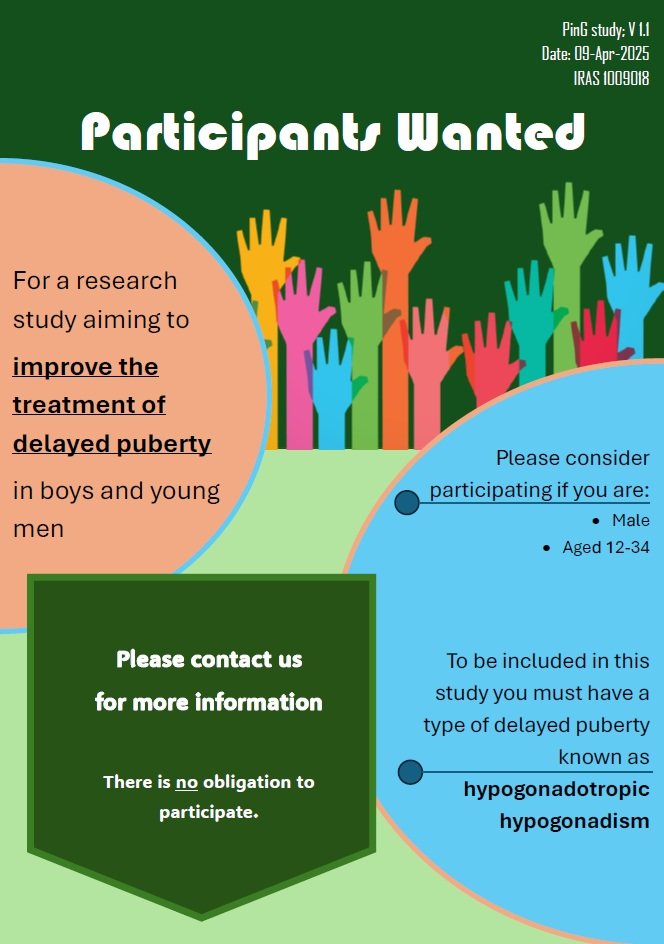
Download the study poster:
About the study
-
Hypogonadotropic hypogonadism (HH) is a lack of reproductive hormones, the chemical messages that control puberty (changing from a boy into a man). It affects around 1 in 2000 boys and men. Here is a patient information leaflet that explains about HH and the possible treatments for puberty. Download this information leaflet for more information.
There is lots that we know about helping boys and young men with HH go through puberty, but we also know we can do it better. This study is needed to make sure we give the right combination of medicines to help boys and young men complete their puberty.
-
This study aims to identify the best treatments for induction of puberty in boys and young men with delayed, absent or stalled puberty due to HH.
We are comparing different combinations of medicines called gonadotropins (reproductive hormones that control puberty) to see what works best to help boys and young men to go through puberty and be able to make sperm (to be fertile and parent a child later in life). We know that these gonadotropin medicines are able to help boys and young men with HH to go through puberty and make sperm, but we don’t yet know the best combination or order in which to give these medicines.
-
The current standard treatment to induce puberty in boys and young men with HH is testosterone (usually as regular injections into the muscle). Testosterone helps to increase height, muscle mass, body hair, size of the penis, voice deepening, energy levels and libido (sexual desire). However, testosterone does not lead to development or increase size of the testicles and men with HH on testosterone treatment do not produce sperm.
With gonadotropins, the testicles are stimulated to grow and develop and to make testosterone, leading to all of the changes that happen with testosterone injections. As well as this, the testicles can develop enough to be able to produce sperm.
Studies of adult men with this condition suggest that well-being and quality of life is improved for men on gonadotropins as compared to testosterone. In addition, men who have had previous treatment with gonadotropins are able to make more and better-quality sperm with fertility treatment, and a shorter length of time is needed for adult fertility treatment. However, we don’t have long-term follow up data yet for puberty induction.
-
The study treatment will require regular subcutaneous injections 2-3 times per week at home. Although these are painless or minimally painful, they need to be done regularly as the medicines will not work as well if doses are missed. You will need on average 2-3 more blood tests on gonadotropin treatment than is needed on testosterone treatment to induce puberty.
The gonadotropin treatments are usually well tolerated, with minimal side effects. These side effects include increase spots (acne) or some development of breast tissue, but these may occur with standard treatment with testosterone as well. If these side effects occur, they can be managed by reducing the dose of gonadotropins.
Other side effects include pain or reaction at the injection site or varicocele (localised swelling of the testicle). These side effects are more likely if too much of the medicine is given by mistake. This is why we carefully check your blood levels at each appointment to make sure you are taking the right amount of the medicines.
-
If you decide to take part, you will have some blood tests before starting the medicines, and regular blood tests during the treatment to check that everything is working well, and to look for any genes changes that might explain you developing HH. You will have an ultrasound scan of your testicles before starting the medicines and at your regular hospital appointments. We will ask you to fill in a questionnaire about how you feel day-to-day before starting the study, and again at the end of the study to see if this has changed at all. We expect that you will be on these medicines for 18-24 months. At the end of the treatment with these medicines, we will ask you to provide a semen sample to see if you able to make sperm. At the end of the study, you will continue to be looked after by your hospital team and will continue treatment as required.
We will also invite you to take part in an optional interview to understand your experiences. This helps us understand more about what it’s like to receive the treatment, but it’s up to you if you do it.
For more detailed information download our patient information sheet
We are hoping to recruit both boys and young men, so we have information about the study suited to a range of ages. Here you can find detailed information on the study depending on who is thinking of joining.
Who we are
MRC & NIHR
Funder

The research is funded by the Efficacy and Mechanism Evaluation Programme, an MRC and NIHR partnership, sponsored by Queen Mary University London and has been approved by a research ethics committee.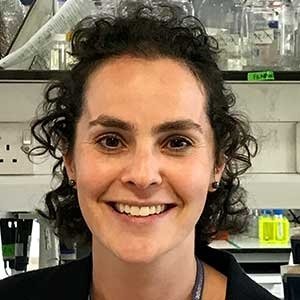
Barts Cardiovascular Clinical Trials Unit
Dr Sasha Howard
Chief InvestigatorClinical Reader and Honorary Consultant, Queen Mary University London and Barts Health NHS Trust
Dr Howard is an expert in Paediatric Endocrinology. She worked in Paediatrics at Great Ormond Street and UCLH before completing a PhD in Molecular Endocrinology.
Clinical trials unitBarts Cardiovascular Clinical Trials Unit (CVCTU) delivers research in the pursuit of therapeutic break throughs for patients as a distinguished branch of the Barts UKCRC registered unit.